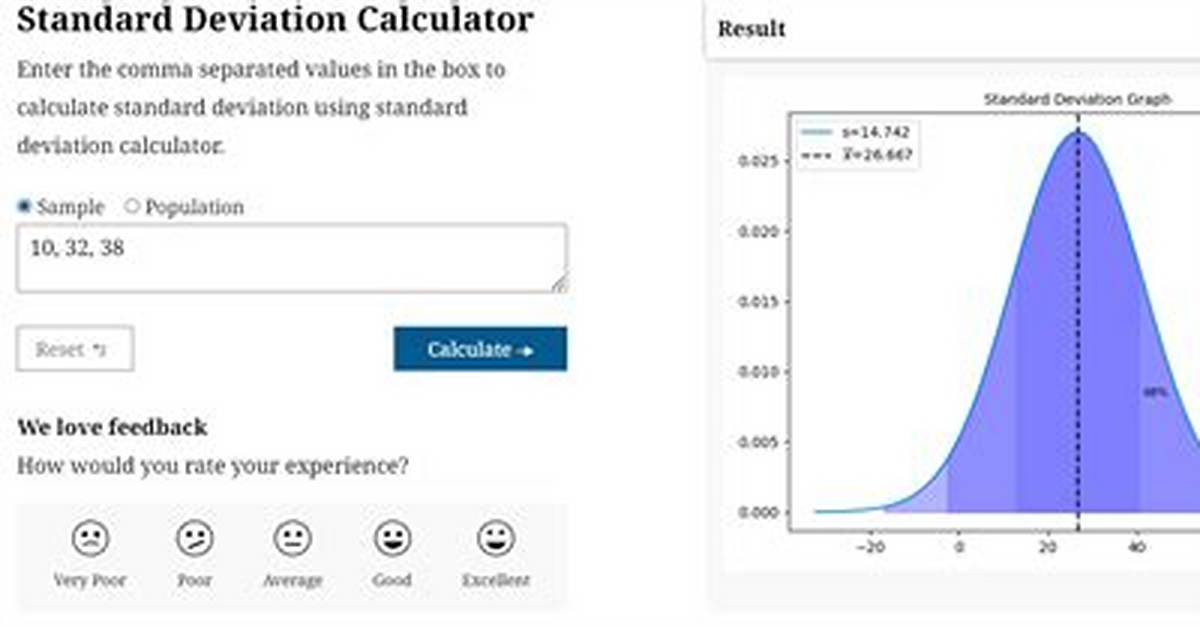
Are you looking for the best standard deviation calculator tools to calculate SD in 2023? Look no further as we present a comprehensive list of the top tools that will simplify complex calculations and provide precise results. Whether you are analyzing statistical data, assessing risk, or working on financial analysis, these tools will streamline your calculations and save you time.
- Standard deviation calculators are essential tools for calculating variability in data.
- These calculators can also calculate variance, mean, and coefficient of variation for a given set of numbers.
- Both population and sample data can be analyzed using standard deviation calculators.
- The standard deviation formula differs for population and sample data sets.
- Standard deviation is widely used in statistics, probability theory, quality control, climate analysis, and finance.
Now let’s dive deeper into what exactly a standard deviation calculator is and how it can help in your data analysis journey.
What is a Standard Deviation Calculator?
A standard deviation calculator is a powerful tool used to calculate the standard deviation of a set of numbers, allowing for quick and accurate analysis of data variability. Standard deviation is a statistical measure that quantifies the amount of variation or dispersion within a dataset. It helps in understanding how closely the individual data points are clustered around the mean, providing insights into the consistency or variability of the data.
Using a standard deviation calculator simplifies the calculation process and eliminates the need for manual computations. By entering the values of the dataset, the calculator automatically calculates the standard deviation, variance, mean, and even the coefficient of variation. This saves time and ensures accuracy in data analysis.
Calculating Standard Deviation
The formula for calculating standard deviation depends on whether you are working with population data or sample data. For population data, the formula is:
? = ?[(xi – ?)²/N]
Where ? represents the population standard deviation, xi is each individual data point, ? is the population mean, and N is the size of the population.
For sample data, the formula is slightly different:
s = ?[(xi – x?)²/(N-1)]
Here, s represents the sample standard deviation, x? is the sample mean, xi is each individual data point, and N is the size of the sample.
A standard deviation calculator automatically applies the appropriate formula based on the data provided, making it easy to obtain accurate results.
Table: Standard Deviation Calculator Functionality
| Functionality | Description |
|---|---|
| Standard Deviation | Calculates the standard deviation of a dataset. |
| Variance | Provides the variance of the dataset. |
| Mean | Calculates the mean (average) of the dataset. |
| Coefficient of Variation | Calculates the standard deviation expressed as a percentage of the mean. |
A standard deviation calculator offers these functionalities, allowing for comprehensive analysis of data and providing valuable insights into the variability and consistency of numerical datasets.
Understanding Standard Deviation Formula
To calculate the standard deviation, it is essential to understand the formula that underlies this statistical measure. There are two main formulas for calculating standard deviation – one for population data and another for sample data.
For population data, the formula is given as ? = ?[(xi – ?)2/N], where ? represents the population standard deviation, xi denotes each individual data point, ? is the mean of the population, and N is the size of the population.
When working with sample data, the formula changes slightly to take into account the degrees of freedom. The standard deviation for sample data is calculated using the formula s = ?[(xi – x?)2/(N-1)]. Here, s represents the sample standard deviation, x? denotes the mean of the sample, and N is the size of the sample.
Remember, the standard deviation measures the spread or variability of a set of numbers. It is widely used in various fields such as statistics, probability theory, quality control, climate analysis, and finance to assess risk and understand the consistency of data. By calculating the standard deviation, you can gain valuable insights into the distribution of data points and make informed decisions based on accurate statistical measures.

